

Rhythms of the End: A Farewell

Grey autumn morning, 1970. The sky pressed down on the city, a blanket of heavy clouds smothering every trace of light. The Tagus River, usually silver, mirrored the leaden hue above—dark, almost motionless, as if it too felt the weight of that day. The Lisbon docks, with their worn stones, bore the marks of decades of departures and returns, saturated with stories of comings and goings.
Farewells dictated the rhythm of the morning. Young mothers, pale and tear-streaked, clutched their children tightly, offering their husbands quick embraces and glances brimming with fear and uncertainty. Their goodbyes were restrained, as though silence was the only way to bear the pain. Words were swallowed, so children would not understand, so husbands would not carry yet more guilt aboard the waiting ship.
Children clung to their mothers’ skirts—some crying, others watching in silence, confused, unable to comprehend why their fathers had to go. Elderly faces, weathered by time, looked on from a distance, knowing all too well the meaning of absence. Fine, stubborn rain fell, mingling with tears, running into small rivers of water and sorrow along the uneven stones of the pier.
Nearby, the ship stood ready to take fathers, brothers, husbands, and sons to a war that was not theirs—while on the dock remained the women, children, and old men, abandoned to emptiness and the endless ache of farewell.
That day’s goodbye was not just an act—it was an open wound, a silent dance of hands releasing, bodies drifting apart, and hearts already burdened with absence. It was the beginning of a pain that all would carry—on the dock and on the ship, in the silence of homes and in the echo of trenches. A farewell that sealed separate lives, bound to waiting, uncertainty, and the fragile hope of reunion.
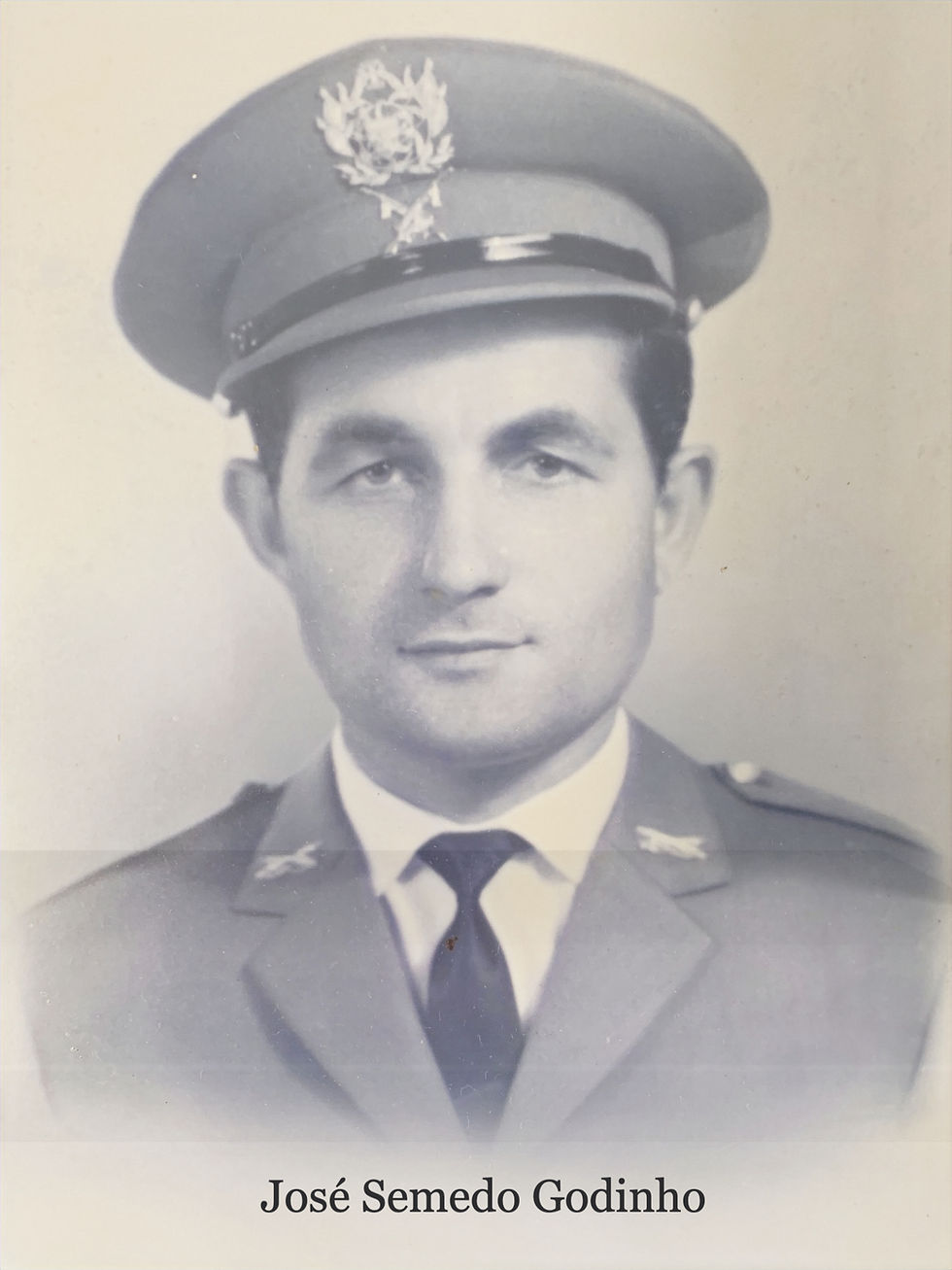
Tété was only nine years old. Too young to grasp the meaning of the farewell, but old enough to feel its crushing weight. Her father, dressed in olive-green uniform, waved from the deck—a strong yet weary man, worn down by shattered dreams, by battles against landowners, by labor that broke more than it sustained. The war in Africa was an escape from the fields, but also a prison.
Her eyes never left him. On the boat he seemed larger, more distant, already unreachable. Around her, mothers wept, children clung to their grandmothers’ skirts, and soldiers gripped trembling cigarettes in their hands, trying to mask their fear. Tété felt something profound—something she can describe now, though at the time it was only a mystery.
At home, emotions were buried like seeds never meant to sprout. No talk of war. No talk of the fascist regime. No talk of tears. They survived in silence. But on that dock, something was born in her: a confused pain, an early longing, a knot that tightened her small chest and reverberated in her stomach.
Six decades later, she still recalls that day and the mark it left on the woman she became: the dark pier, her father’s slow wave, the farewell steeped in funereal sorrow. It shaped her relationship with attachment, absence, and the fragility of human bonds. That farewell was not only the loss of a father she loved—it was her first glimpse of a painful truth: life is woven from cycles of meeting and parting, arrivals and departures, a dance between life and death.
Her father left that day for a distant war, but his absence never truly ended. It lingered in the silences of their home, in the void of everyday life, in the words never spoken. That farewell became her first lesson in the rhythms of endings—in how life is punctuated by moments that draw us closer to the inevitable, the unknown, the final goodbye.
Today, she sees that the rhythm of death endures unchanged. Places, faces, flags may shift, but farewells repeat themselves in an endless cycle. Nations still carve their histories in sacrifice—lives offered up for territories, ideologies, flags, religions. But why hasten death? Why prolong this dark dance that diminishes Life?
Tété reflects: that moment on the pier, though painful, revealed a universal truth—that life is a journey braided with goodbyes, each one carrying the potential for transformation, even when veiled in pain. Deep inside, she knows death is part of the dance of existence, but it should not be forced by violence or war. Death should come as the natural close of a cycle—sometimes sudden, unpredictable, but always bearing the dignity and meaning that life deserves.
Rhythms of the End: Dances and Journeys with Life and Death became more than a title for Tété. It became a journey—an attempt to balance memory with the emptiness of loss. An effort to transform each goodbye into an encounter with oneself, with the essence of living fully. Because each farewell carries not only the weight of loss, but also a lesson—an invitation to reassess what we value, how we connect, how we participate in the eternal dance between life and death.
Isn’t there another way to live? Can we not abandon what has persisted for centuries—aggression, cycles of pain, endless loss? Don’t all lives deserve to unfold in peace?
The Lisbon docks were more than a place of departure; they were a stage where farewells carved invisible chaos into homes, families, and souls. It was there that silence began—an echo reverberating across generations. Looking back, Tété wonders: what passed through the minds of those mothers, fathers, children, soldiers that day? What did they feel, watching loved ones leave for a war that was not theirs? And what of today’s politicians, who still perpetuate these violent farewells, these forced departures that spread pain, longing, and destruction? How long will we keep repeating the same mistakes, turning life into a stage of suffering in the name of empty ideals, borders, and flags? When will we finally learn to prize peace over power, human connection over division?
Her father’s wave remains vivid in memory, etched with painful clarity. His hand moved slowly through the air as the ship drifted away. It was not only the wave of a father—it was the gesture of dozens, perhaps hundreds of men, all raising their hands in farewell.
On the pier, women young and old waved white handkerchiefs, the same handkerchiefs used to wipe away endless tears. They fluttered as though they might reach the men who were leaving, as though fabric could hold on a little longer. Confused children mimicked their mothers, repeating gestures without grasping their meaning. It was an improvised choreography of pain and longing, a silent dance binding those departing and those left behind.
That farewell—her father’s wave, Tété’s silence—became one of the many moments that form the Rhythms of the End: an unavoidable dance between departures and returns, between life and death. On that pier, where tears mingled with rain and with the river Tagus, the goodbye was not only the separation of bodies, but also the loss of an ideal, the proof that humanity has yet to learn to live without turning endings into imposed suffering. And yet, within that rhythm, Tété glimpsed a truth: that though farewell is part of life, it can also be an invitation—to reflect on how we wish to dance with the time we are given.
There is still time to change the rhythm, she believes. Still time for the end to be a passage, not a sentence of suffering. That the chaos of docks and the chaos of war might give way to something new—a dignified life for all. A farewell, at last, to the cycle that imprisons us.
In memory of my father 1933-2021


Comments